
What Every Parent Can Learn from a Nanny
Listen to This Post
Can a nanny teach a parent about parenting? We don’t always say it out loud, but yes, sometimes the person who isn’t the parent sees what the parent can’t. Not because parents don’t care, but because they’re living inside the story. After working in different homes, one thing becomes clear very quickly: no two households are the same. Every family has their own way of doing things, not necessarily right or wrong, just what works for them.
Parents often ask for help with specific problems, the baby won’t sleep, the toddler won’t listen, meals are a struggle. From the outside, it looks like a behavior issue. However, when you’re inside the home, you start to see the patterns behind it. Because when something isn’t working with a child, it’s rarely just about the child.
Sometimes it’s a lack of follow-through. Sometimes it’s parenting from guilt. Sometimes it’s the search for a quick fix instead of a solution that takes time. Nannies step into a family’s world with a rare kind of access, close enough to feel the rhythm of the home, but distant enough to notice what’s hidden in plain sight.
Yet, what’s invisible to a parent often stands out clearly to a caregiver, not as judgment, but as perspective.
The Parent Behind the Parenting
What becomes clearer over time is that parenting is not only about knowing what works. It is also about what a parent can emotionally tolerate.
Some parents know the routine matters, but they struggle with being the one who enforces it. Some want their child to be independent, but step in too quickly because watching them struggle feels uncomfortable. Some want boundaries, but also want the limited time they have with their child to feel warm, easy, and liked.
That is the part nannies often see up close: the space between what a parent believes, what they says they want, and what they are able to do when the child is crying, resisting, or asking for more.

The Work Behind the Work
That’s also where the role starts to feel less like caregiving, and more like something else entirely. You’re not just there for the child. You’re often holding space between different expectations at the same time. What the child needs, what the parent wants, and what they believe should be happening don’t always line up.
You see it when a parent asks for structure, and softens it minutes later. Or when something is discussed and agreed on, but plays out differently in day to day life. And you are there, expected to follow through, but also adjust, read the room, and know when not to.
At the same time, you’re brought in for your experience, trusted to guide, to notice things, to help things run smoothly. And yet, there are moments where that same perspective is questioned, or quietly set aside. Not directly, not in a way that’s said out loud, but in how decisions shift and unvoiced expectations aren't met. And the truth is most of it isn’t even intentional. It’s just what happens when real life happens.

What the Research Shows
What shows up in research echoes what becomes visible over time. Children don’t organize their behavior around single moments, they organize it around what is consistent and reliable. Studies on parent-child interactions show that it is not only how positive a parent is, but how consistent those interactions are that shapes a child’s emotional and physical well-being.
At the same time, research on family routines finds that children in more predictable environments tend to show fewer behavioral difficulties and stronger self-regulation, not because everything is done perfectly, but because the structure around them holds. What matters most is not which adult is present in every moment, but whether the expectations and responses they experience are steady enough to make sense.
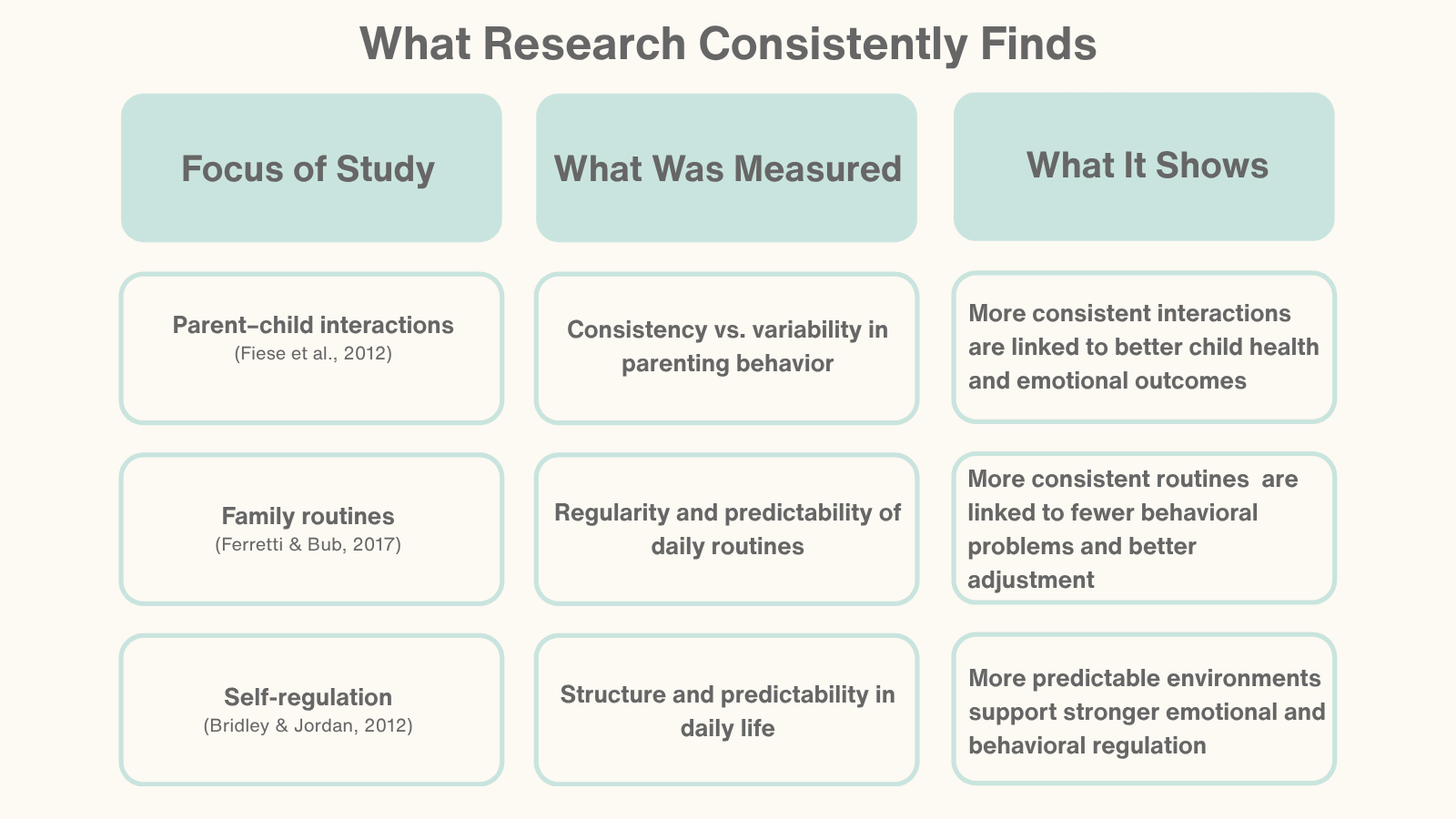
This is also what a nanny starts to see over time. Not a better way to parent, but a clearer one. Not built on perfect routines or constant control, but on consistency that a child can rely on, even when it’s inconvenient. On understanding that what feels small in the moment often isn’t small to a child. And on recognizing that it’s not the intention behind a decision that shapes them, but how often it repeats.
The lesson isn’t to do more, or to do it perfectly. It’s to notice what is happening consistently, even when it doesn’t feel significant, and to decide what you want that to become.
What’s harder in parenting?
Current Results:
More Parent Perspective

Parent Perspective
The Second Child Shift
When the second baby arrives, the nanny dynamic quietly changes in ways families don't anticipate and nannies can't always say out loud.
 B&B Podcast

Parent Perspective
Why Nannies Leave and What Makes Them Stay
Not every nanny role becomes long-term. What makes nannies want to leave, what makes them stay, and how the day-to-day dynamic between families and caregivers shapes both.

Parent Perspective
Buying Back Time: Is Paying for Childcare Really Worth It?
Would you work just to pay the nanny? For many parents, it feels like their entire paycheck disappears into childcare. But the hidden trade‑offs, health insurance, career momentum, and even sanity, tell a bigger story.
If you’re trying to make routines actually work at home, take a look at the Routine Rulebook. It breaks down what tends to help, and what usually gets in the way.

Written by Sylwia Glinska
Founder of Bottles & Bytes • Nanny, Newborn Care Specialist & Childcare Consultant
Get To Know Me